Facilities
Facilities
The Coastal Engineering Laboratory, a two-story 30 m x 38 m facility, is dedicated to laboratory experiments in coastal and ocean processes. This laboratory has high bay experimental space and eleven offices, used for faculty and graduate students in the Coastal Engineering Program.
The major experimental facilities are located in the Coastal Engineering Laboratory and P.S. DuPont Hall.
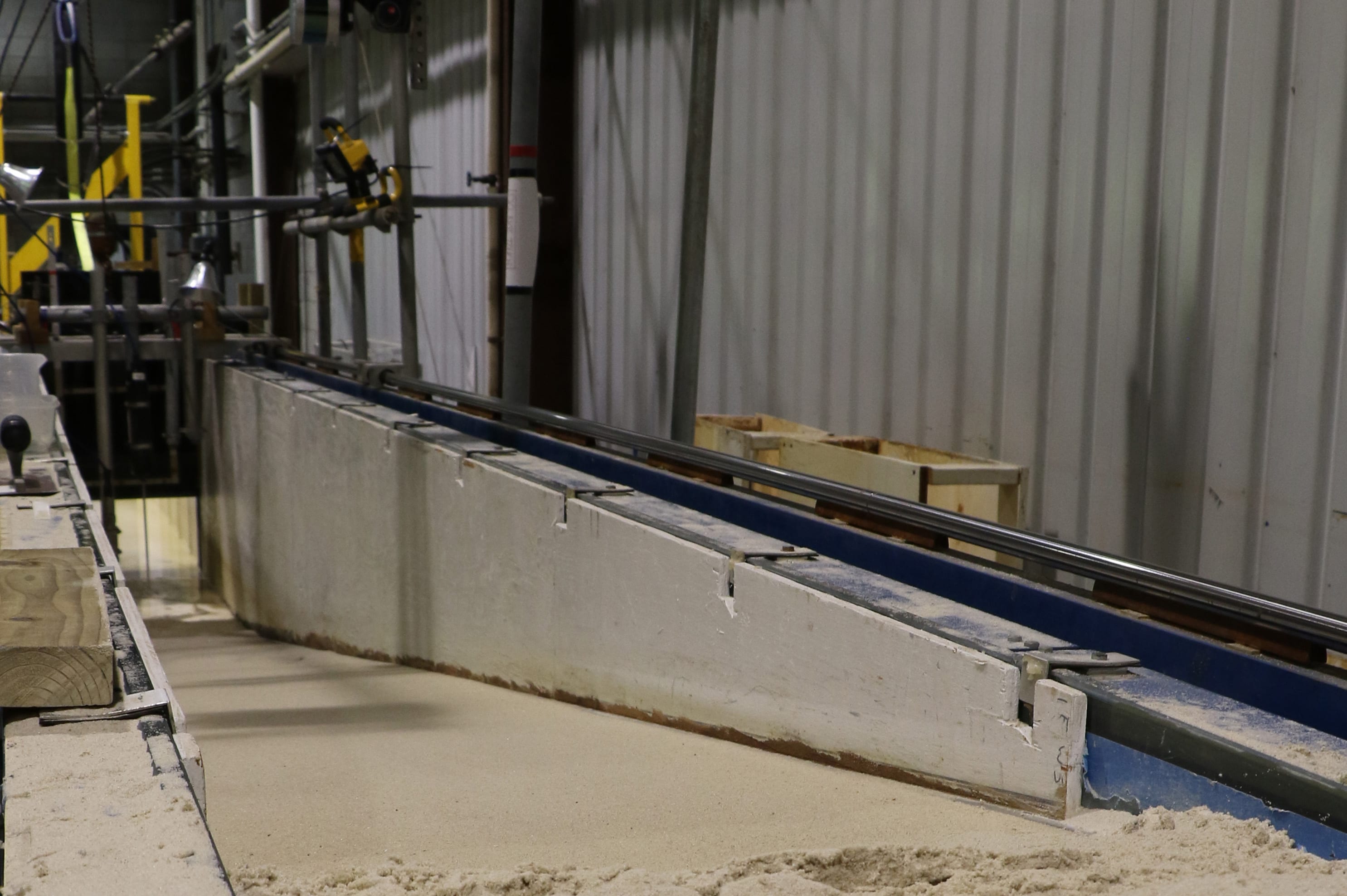
Precision Wave Tank
(33 m long with a 0.6 m (w) x 0.76 m (d) cross section)
Sixty percent of the tank has glass side walls that are aligned with an accuracy of plus/minus 0.5 mm to ensure that no tank irregularities affect the experiments. The tank has a (1m stroke) hydraulically actuated piston wavemaker designed to create the largest non-breaking wave conditions in the tank. The programmable wavemaker is capable of creating sinusoidal, cnoidal and solitary waves, as well as a random sea state. A moveable instrument carriage mounted on rails facilitates measuring waves along the length of the tank. An impermeable adjustable slope can be installed at the far end of the tank. The tank also has recirculating capability. A current of 30 cm/sec can be generated in 50 cm of water.
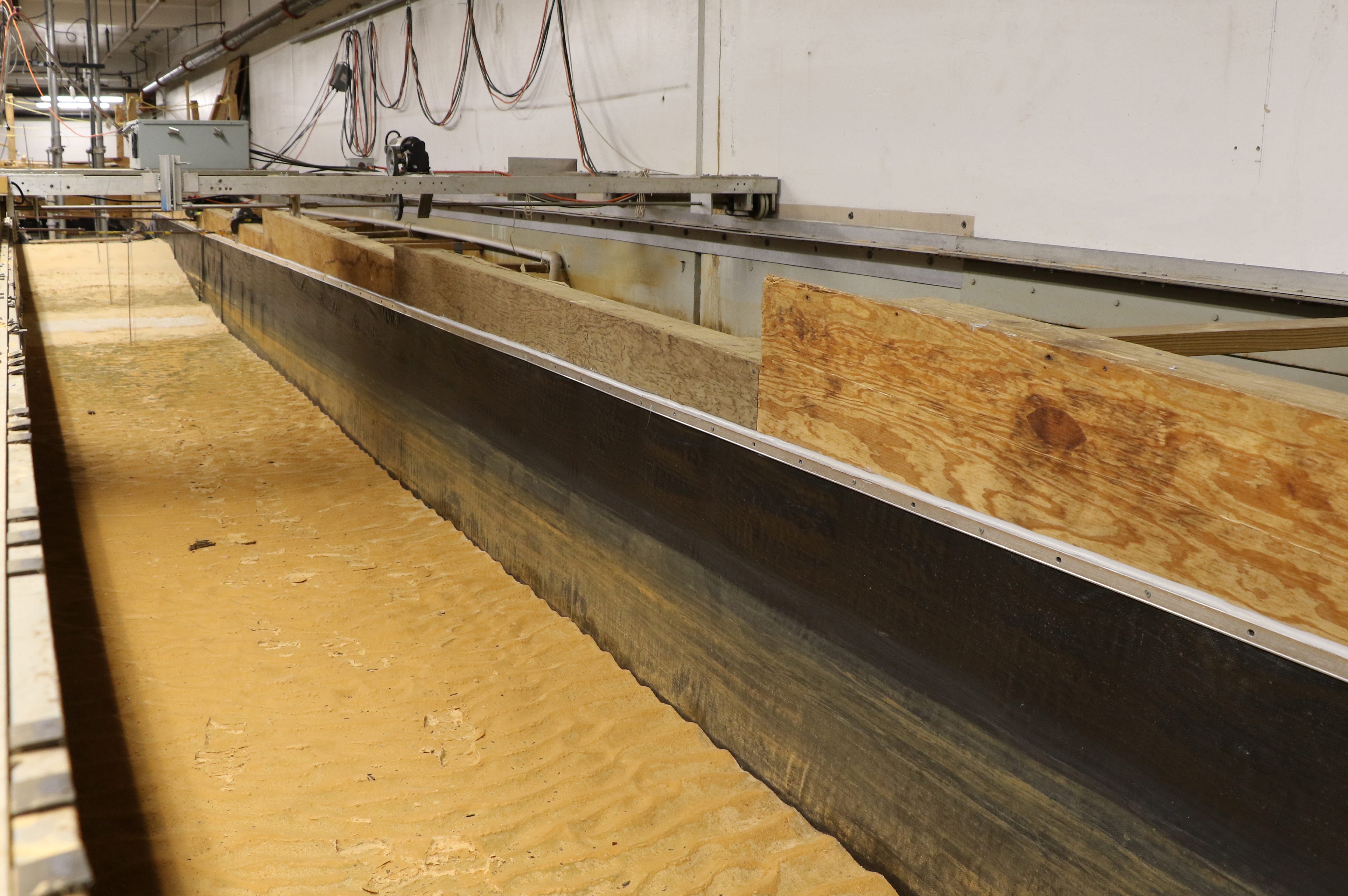
The Sand Beach Wave Tank
A large towing tank/wave tank, with a cross-section of 2m x 1.5m, which is equipped with PCs for wave maker control and data acquisition and three automatically calibrating wave gages. The wavemaker is a hydraulically actuated piston wavemaker.